● Program Overview
“Financing Africa’s Green Future”
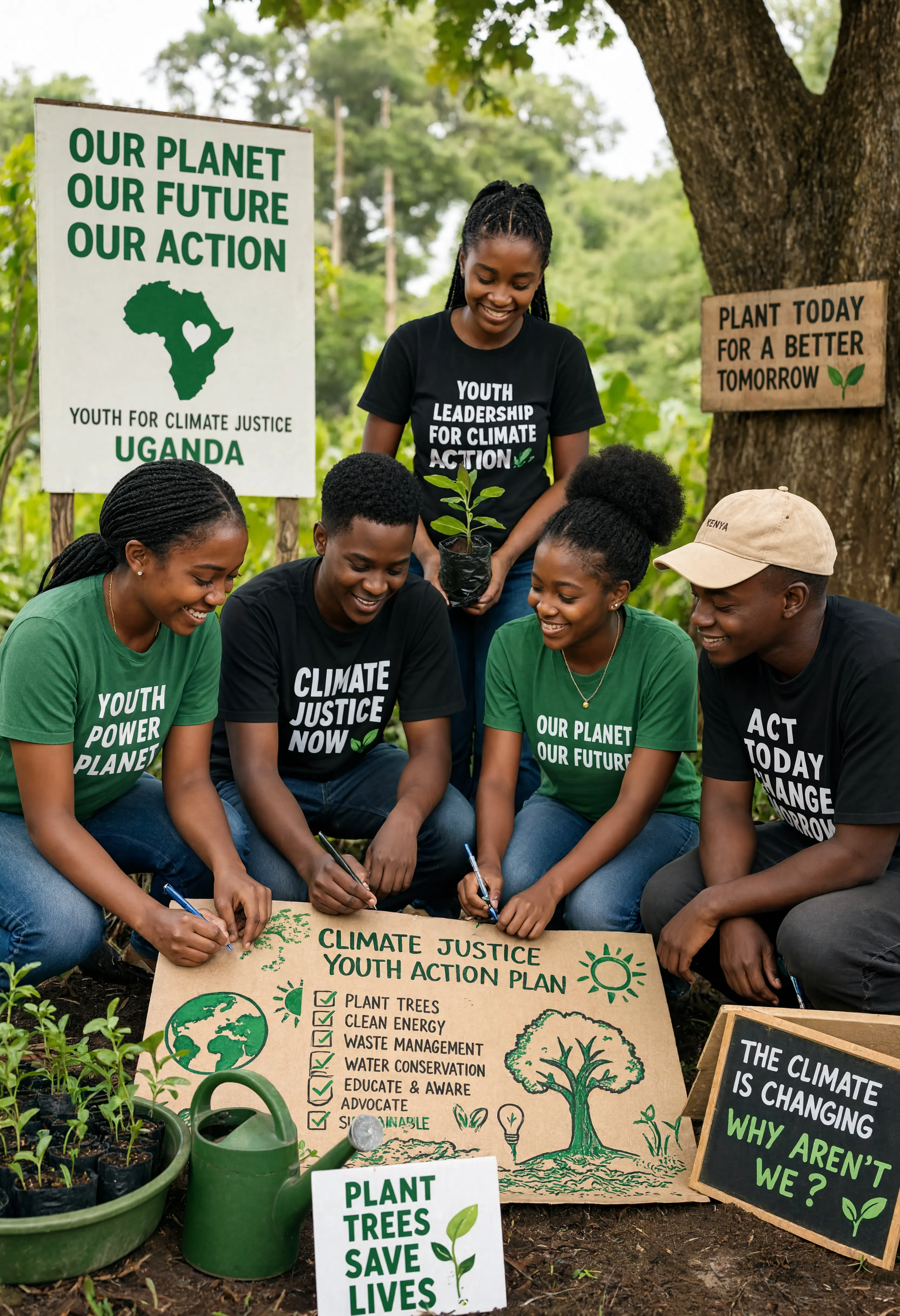
At the Africa Youth Foundation, climate action is a core pillar of our developmental mandate. Africa has the youngest population in the world, with 70% of Sub-Saharan Africa under the age of 30. By 2030, young Africans will constitute 42% of global youth. This massive population represents the continent's most powerful asset to combat environmental degradation and drive a green growth agenda.
We operate on a fundamental truth: environmental change is only sustainable when it is determined, implemented, and owned by the affected communities themselves. The Climate Action Program empowers young Africans to transition from being vulnerable bystanders of the climate crisis into active architects of green literacy, community innovation, and inclusive policy governance.
Why This Program Matters
The numbers demand honesty. Africa contributes less than 3% of global greenhouse gas emissions, yet it stands as the most climate-vulnerable region on the planet. Children and young people across Sub-Saharan Africa face fragile, life-threatening environments characterised by devastating droughts, catastrophic flooding, accelerating resource competition, and the slow-onset hazards that erode livelihoods and displace communities with a quieter but no less destructive force than acute climate shocks. Climate change on this continent is not a future projection — it is a present and compounding reality, felt most acutely by the communities least equipped to absorb its costs.
This vulnerability intersects with a second crisis of equal urgency. Millions of working-age young people enter the African workforce annually into an employment landscape defined by jobless growth and precarious, unstable livelihoods. The green economy represents one of the most significant structural opportunities to address both crises simultaneously — but only if young Africans are equipped, empowered, and positioned to lead within it rather than being left at its margins. The Climate Action Programme bridges these two realities deliberately, treating the green economy not as an abstract transition but as a concrete and accessible pathway to dignified livelihoods, community resilience, and intergenerational environmental ownership.
Program Structure & Operational Pillars
The Climate Action Programme operates across three systemic pillars, each designed to move climate awareness into localised, youth-led action at the individual, community, and governance levels simultaneously. These pillars are not sequential — they are interdependent, each reinforcing the others to produce a compounding effect that neither could achieve in isolation.
The first pillar is Green Literacy and Skill Development. We deploy structured learning frameworks, grounded in our core Capability Handbook, to equip young people with the environmental knowledge, technical skills, and practical competencies that the green economy demands. This is not generic environmental education — it is targeted, contextually relevant skills development designed to match the specific demands of green sectors in the communities and economies where our participants live and work. We bridge the gap between the skills young Africans already possess and the capabilities the green transition requires, creating pathways from climate awareness into climate-ready livelihoods.
The second pillar is Community Eco-Innovation Hubs. We establish and support youth-led local spaces where young innovators design and test accessible, non-capital-intensive ecological solutions tailored to their communities’ specific environmental challenges and resource realities. These hubs function as living laboratories for smart food systems, localised conservation practices, community recycling networks, and circular economy models that communities can own, operate, and sustain without dependence on external expertise or resources. The innovation that emerges from these hubs is not imported — it is grown from within, shaped by the contextual intelligence of young people who understand their environments with a depth and nuance that no outside actor can replicate.
The third pillar is Climate Governance Dialogue Mechanisms. We establish structured dialogue platforms that connect grassroots youth leaders directly with local authorities, national environment ministries, and regional bodies — creating institutionalised channels through which young people’s voices move from community conversation into binding policy. We coordinate youth engagement in climate governance at every level, from municipal decision-making through to Nationally Determined Contributions updates, Africa Climate Summit frameworks, and international climate negotiations. This pillar is built on a single non-negotiable principle: that young people are not stakeholders to be consulted as an afterthought — they are rights-holders whose participation in climate governance is a prerequisite for the legitimacy and durability of any environmental framework that will shape their futures.
3. Scope of Engagement: Targeted Inclusion
Climate change does not affect everyone equally. To ensure true climate justice, our program builds capacity with special emphasis and attention dedicated to historically underrepresented and marginalized groups:
Category
Strategic Focus & Vulnerability Scope
Rural & Informal Settlements
Training youth in urban slums and arid zones to handle slow-onset climate hazards, protect land rights, and manage local resource competition.
Marginalized Identities
Designing inclusive, accessible climate safety toolkits and resilience programs tailored to diverse physical and social identities, including youth living with disabilities.
Climate Migrants & Refugees
Building protection and empowerment pathways for displaced young people, recognizing that climate extremes intensify conflict and drive forced human mobility.
Students & The Diaspora
Actively engaging secondary and higher-education cohorts alongside international diaspora networks to champion nature-based solutions and cross-border knowledge exchanges.
Measurable Program Outcomes
We hold ourselves to specific, trackable outcomes across four domains that together map the full arc of the programme’s ambition — from community-level environmental practice to continental-scale policy transformation.
The first outcome domain is the scaling of localised nature-based solutions. We measure the youth-driven deployment of context-specific environmental practices, including tree planting initiatives, ecosystem restoration projects, and the protection of biodiversity hotspots in communities where young environmental leaders have been equipped and activated through our programme. These are not externally managed conservation projects — they are community-owned ecological interventions designed and implemented by young people with deep knowledge of the landscapes they are working to restore.
The second domain is the expansion of circular enterprise skills. We track young people’s deployment of affordable, clean-tech innovations — from composting food waste and scaling community recycling infrastructure to dramatically reducing post-harvest storage losses that cost smallholder communities livelihoods as well as carbon. These skills translate directly into green livelihoods, demonstrating to young Africans and to the broader development sector that circular economy participation is an accessible and viable economic pathway, not a specialist pursuit available only to the already-advantaged.
The third domain is e-mobility and technological value chains. We position tech-savvy young Africans at the centre of low-carbon transitions — integrating localised e-mobility frameworks, digital climate advocacy tools, and clean transport innovations into community practice. Young people are not merely users of these technologies — they are their designers, deployers, and champions, building the value chains that make low-carbon transition economically meaningful and community-owned rather than externally imposed.
The fourth domain is institutionalised policy embedding. We measure the meaningful, systemic participation of youth delegates in national climate frameworks, NDC updates, and regional multilateral processes. This is the outcome that transforms the programme’s community-level work into continental and global impact — securing the institutional changes that outlast any individual project cycle and ensuring that Africa’s climate governance reflects, in its foundations and its ambitions, the priorities of the generation that will determine whether its commitments are met.
● Program Overview
-
This program focuses on building green capabilities, climate literacy, community-led ecological innovation, and policy advocacy. It aims to mobilize Africa's youth demographic to lead sustainable, localized environmental preservation and climate adaptation projects.
-
No. While the Climate Action Program provides intensive technical mentorship, peer-led training, and capacity frameworks, direct financial grant-making is handled under our entirely separate Climate Funding Track.
-
We focus heavily on accessible, low-barrier, non-capital-intensive innovations. This includes food systems transformation (like composting and waste reduction), circular economy practices, clean energy literacy, and e-mobility solutions.
-
Through our structured Climate Dialogue Mechanisms, we connect grassroots youth leaders directly with local authorities, national environment ministries, and regional bodies. Our program outcomes actively help consolidate youth statements to directly inform key milestones, such as the Africa Climate Summit frameworks and international climate negotiations.